
What Financial Data Do Investors Expect During Fundraising?
By HybridCFO Team, Editorial Team

Investors are evaluating the market, product and growth opportunity. But they're also deciding whether they trust the founders to understand the business, allocate capital, and respond when the plan changes.
That trust is built when the numbers are current, consistent and connected to a credible story. A founder should be able to explain what has happened, what the company expects next, and how different outcomes affect cash, runway and milestones.
A real-time platform provides clarity and flexible scenarios. An experienced CFO tests the assumptions, prepares the financial narrative, and helps the founder answer difficult questions with confidence. The question behind every number an investor asks about is the same one: can this founder manage the capital we invest?
The investor-readiness checklist
The financial data every founder should have ready
A document isn't investor-ready simply because it exists. It has to be current, consistent, and understood by the founder presenting it.
Start with where you are
Before discussing the future, founders should be able to explain the company's current financial position and how it has changed over time.
- Cash and runway - how much cash is available, where it sits, and how long it lasts under the current plan.
- Burn and spending - gross burn, net burn, major cost categories, and the decisions driving changes.
- Revenue quality - growth, recurring revenue, customer concentration, collections, and the durability of income.
- Performance vs. plan - where actual results differ from budget, and whether the variance is temporary or structural.
Show more than one future
Investors know the base plan won't unfold exactly as expected. What builds confidence is seeing that management understands the variables and has planned for different outcomes.
- Base case - what is most likely to happen? A realistic operating plan built on assumptions the team can defend.
- Upside case - what could accelerate? How additional capital, stronger demand or faster execution can create value.
- Downside case - what if growth or funding takes longer? The triggers, trade-offs and actions that protect runway.
The goal isn't to predict perfectly. It's to demonstrate that the company can recognize change and respond deliberately.
Connect capital to outcomes
A use-of-funds slide should do more than divide the round between product, sales and hiring. It should show how each investment advances the company toward specific milestones: how much you're raising, where it will be invested, what the company will achieve, how long the plan will be funded, and what becomes possible after that.
The story investors need to understand is simple: this capital funds this plan, reaches these milestones, and leaves the company in a stronger position.
One source of truth
Nothing damages confidence faster than numbers that change from one document to another. Revenue in the deck should reconcile with the model. The runway calculation should match the cash plan. Hiring should appear in both the operating narrative and the forecast.
- Pitch deck - the concise investor narrative
- Financial model - the assumptions and detailed forecast
- Data room - the evidence behind the story
- Live dashboard - the current operating reality
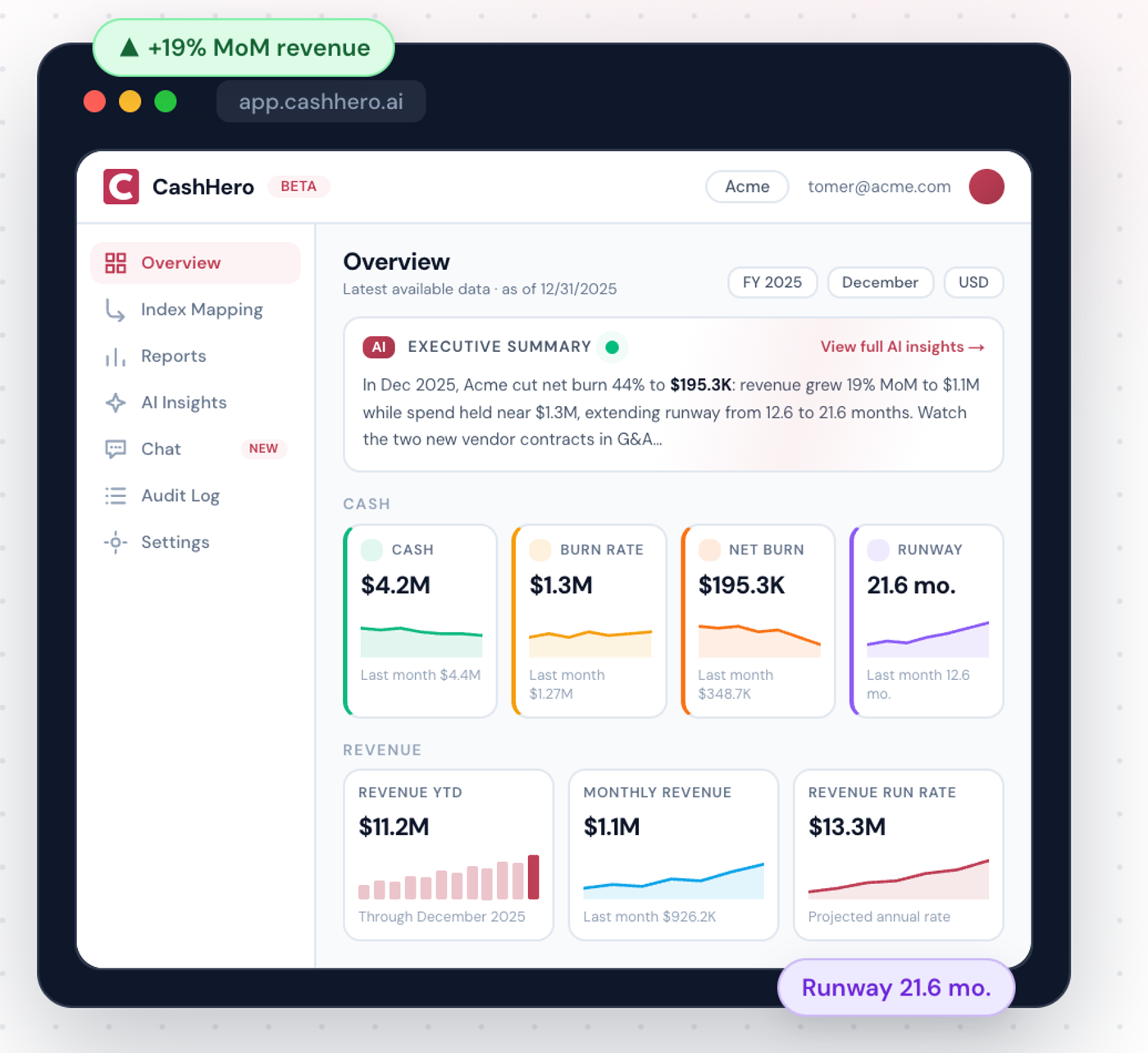
When information is spread across disconnected files, every update creates another opportunity for inconsistency. Real-time financial infrastructure - like the live view CashHero.ai gives founders and CFOs - gives the company one current foundation for every investor conversation.
Be ready to explain
Founders should expect - and prepare for - questions like these:
- What assumptions drive the forecast?
- Why did actual performance differ from plan?
- How does this round change runway?
- What happens if revenue arrives six months later?
- Which milestones must be reached before the next round?
- What would management cut first in a downside case?
- How will the finance function scale with the company?
The strongest answer isn't always the most optimistic one. It's the answer that shows the founder understands the business and has a plan.
The investor-ready founder
The goal isn't to make every number look perfect. It's to demonstrate that the founder understands the business, has considered different outcomes, and knows how to respond.
What creates trust is a founder who is informed, prepared and in control - supported by real-time intelligence and an experienced CFO who validates the assumptions, connects the numbers to strategy, prepares the founder for investor questions, and keeps every update consistent.