
How Much Runway Does My Startup Really Have?
By Sagit Shachaf, Team Leader, CFO / HybridCFO.ai

When founders ask how much runway they have, the answer often sounds deceptively simple: cash divided by burn. But the number is only as reliable as the assumptions behind it - and in a fast-growing startup, those assumptions can change quickly.
Revenue may be growing while collections are delayed. A new hire may be affordable under one sales scenario and risky under another. A funding round expected in six months may take twelve. Any one of those changes can materially alter the company's position.
Runway should be managed as a live decision system, not a number checked occasionally. Founders need current data, scenarios they can change, and an experienced CFO who can turn the results into decisions.
What startup runway actually means
Runway estimates how many months a company can continue operating before its available cash runs out, assuming the current pattern of cash inflows and outflows continues:
Available cash ÷ average monthly net burn = estimated runway
It's a useful starting point - not the final answer.
- Use cash you can actually access. Restricted funds, trapped cash, and balances needed for near-term obligations may not be fully available.
- Use net burn, not only expenses. Net burn is the cash the business loses after cash receipts. Timing of collections can materially change it.
- Test the assumptions. The simple formula assumes the future behaves like the recent past. A startup rarely does.
Four things can change the picture quickly
- Hiring - a new employee adds salary, benefits, equipment and often recruiting costs before the expected growth arrives.
- Collections - signed revenue is not cash. A delayed customer payment can tighten runway even when sales are on plan.
- Growth assumptions - a slower sales cycle, lower conversion or higher acquisition cost can change both revenue and burn.
- Fundraising timing - a round that slips by a quarter can force decisions earlier, when the company has less leverage.
The question isn't whether the model will change. It's whether founders will see the change early enough to respond.
One company, three possible futures
Optimal
16+ months
Realistic
8 months
Downside
7 months
Values shown are illustrative.
A new hire, a delayed customer payment, or a postponed funding round can move the business from the optimal path to the downside scenario. Each scenario should lead to a different plan, not just a different chart:
| Scenario | What changes | The CFO question |
|---|---|---|
| Optimal | Growth exceeds plan | Which investments can we accelerate without weakening control? |
| Realistic | Base assumptions hold | What milestones must we reach before the next funding conversation? |
| Downside | Revenue or funding slips | Which costs can move, and what trigger tells us to act? |
A live model makes the company more agile. An experienced CFO makes sure agility doesn't become reactive decision-making.
Technology and CFO judgement, working together
Technology can keep the data current, connect financial sources, and recalculate scenarios. But even an AI-powered platform can't decide which assumptions are credible, what trade-offs a founder should make, or how to explain the plan to investors.
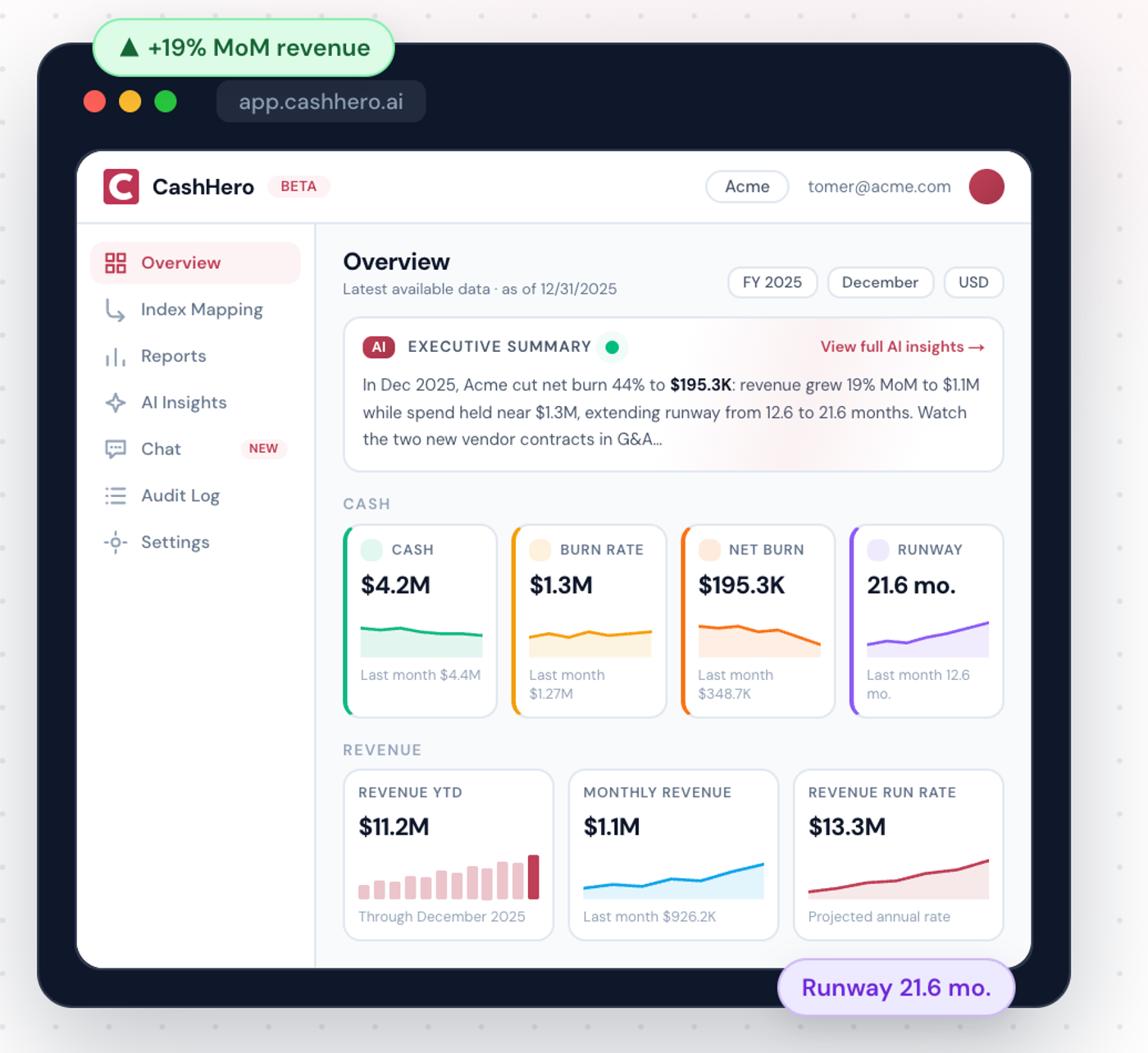
A great CFO can answer those strategic questions - but only with timely, reliable data and analysis tools. That's the model behind Hybrid CFO: an always-on platform that keeps cash, burn, runway and performance in one connected view, paired with a real CFO who challenges assumptions, reads the implications, sets priorities, and prepares founders for what comes next.
"Runway is one of the most fragile assumptions in a fast-growing startup. One new hire, a delayed payment or a change in the fundraising timeline can shift the picture overnight. Always-on financial visibility lets a CFO test those changes early and help founders make hiring and investor decisions with confidence."
- Sagit Shachaf, Team Leader, CFO / HybridCFO.ai
For founders, that means fewer surprises and stronger conversations with investors, boards and leadership teams.
Built for global startups
Multiple entities, currencies, bank accounts and teams make runway harder to understand. Cash may sit in different places, costs may move with exchange rates, and each market can bring different obligations.
Hybrid CFO brings those financial sources together while an experienced global CFO helps founders understand the risks, trade-offs and timing behind each move.
The question to ask isn't "what is our runway?" It's "what changes it - and what will we do next?"